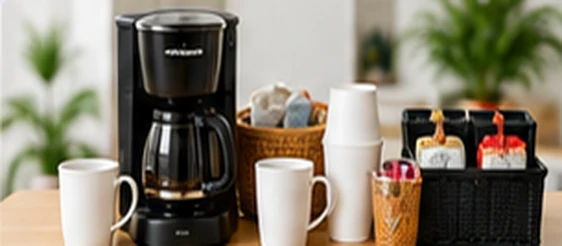
Breakroom beverage orders can be surprisingly uneven. Teacher workdays, parent events, in-service training and summer programs create different demand. The best approach is a lightweight consumption tracker, not a one-time guess based on total employee headcount.
Make a three-part beverage inventory
| Group | Examples | Unit to track |
|---|---|---|
| Single-serve | Bottled water, canned drinks and certain pods | Bottles, cans or servings per case |
| Concentrated / prepared | Drink mixes, brewed tea and brewed coffee | Packets, gallons or brewed servings |
| Supporting supplies | Cups, lids, stirrers and sweeteners | Actual units per carton |
Estimate base monthly demand
Start with the number of people who regularly use the room, average servings per person and operating days. For example, 18 daily users each taking one drink on 20 working days suggests a starting demand of 360 servings, before meetings or visitors. Compare that with recent consumption and avoid assuming every employee takes the same drink.
Convert servings to cases
A case may contain 24 bottles, 30 bottles or another quantity; a tea carton may contain bags grouped into boxes. Divide forecast servings by usable case count and round up only to a sensible ordering unit. Track remaining stock by format instead of mixing “cases” and “each” in one inventory cell.
Adjust for storage and seasonality
Temperature, available refrigerator space and delivery access can change optimal purchasing quantities. Rotate stock by marked dates and store according to package instructions. Water demand in a gym may differ sharply from coffee demand in the main office; manage them separately if needed.
A simple reorder rule
Set a reorder point using average consumption during supplier lead time plus a small, explicit reserve. Revise it after several cycles rather than defaulting to the largest available bulk discount tier. Ordering more than you can store safely is not a saving.
School purchasing checklist
- Record beverages by exact SKU and units per case.
- Estimate demand by room and event calendar.
- Count actual remaining servings and storage capacity.
- Set a reorder point and a maximum storage quantity.
- Include compatible cups, lids and preparation supplies.
Frequently asked questions
Should every school use the same breakroom beverage mix?
No. Start with local consumption, storage and staff preferences.
Does a bigger case always lower costs?
Only when the units are used within their useful life and fit storage limits.