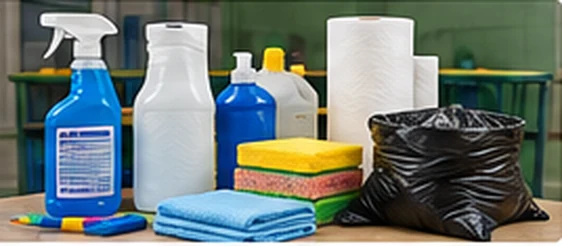
A school cleaning supply list may contain detergents, multipurpose cleaners, sanitizers and disinfectants. These names describe different functions, and substituting one for another can lead to wasted supplies or poor results. The safest purchasing process starts with the surface, the task, the approved product label and the staff procedure.
What each product is intended to do
| Product type | Typical role on a hard surface | Purchasing question |
|---|---|---|
| Cleaner | Removes visible soil, grease or organic material | Is it compatible with the floor, desk, fixture or finish? |
| Surface sanitizer | Reduces specified bacteria according to approved label claims | Does the label cover the intended surface and application? |
| Disinfectant | Kills or inactivates specified microorganisms under label conditions | Which organisms, surfaces and contact times appear on its label? |
Some EPA-registered products have more than one function. A disinfectant may also clean; a sanitizer can be formulated for a particular application. Do not infer that a product has antiviral efficacy simply because its label says sanitizer. Use the actual approved claims.
Contact time is a purchasing specification
Disinfectant performance depends on the directions, including how long the treated surface remains wet. Staff need the correct concentration, application method and contact time. An advertised quick application is not permission to wipe a product dry before the stated time. Different labeled targets on one product can even require different contact times.
Consider school surfaces and storage
Desk laminates, painted finishes, electronics, food-contact surfaces and restroom fixtures may require different procedures. Check product compatibility and any rinse instructions, especially around food preparation. Keep concentrated chemicals and refills in approved locations away from students; use school safety procedures and the product's Safety Data Sheet.
Compare ready-to-use, concentrate and wipes
Ready-to-use bottles can simplify training but occupy storage space. Concentrates may lower packaged volume but require accurate dilution equipment. Wipes reduce dispensing complexity yet generate solid waste and may dry out in poor storage conditions. Cost comparisons should include the correct dilution, effective coverage, case units and labor—not merely the price printed on the bottle.
School purchasing checklist
- Identify the cleaning or antimicrobial claim needed for each task.
- Verify EPA registration and labeled organisms where disinfection is required.
- Check approved surface, dilution, wet contact time and any rinse requirements.
- Confirm staff training, PPE, storage and SDS access.
- Record the exact SKU and dispenser or dilution-system compatibility.
Frequently asked questions
Does cleaning alone disinfect a surface?
No. Ordinary cleaning removes soils; disinfection requires an appropriate product used according to its approved directions.
Can a school switch disinfectants based only on price?
Check the full label, hazards, surface compatibility, contact time, concentration and required procedures before switching.
Technical reference: EPA: Cleaning, sanitizing and disinfecting explained. Verify actual product specifications and current site procedures before purchasing.